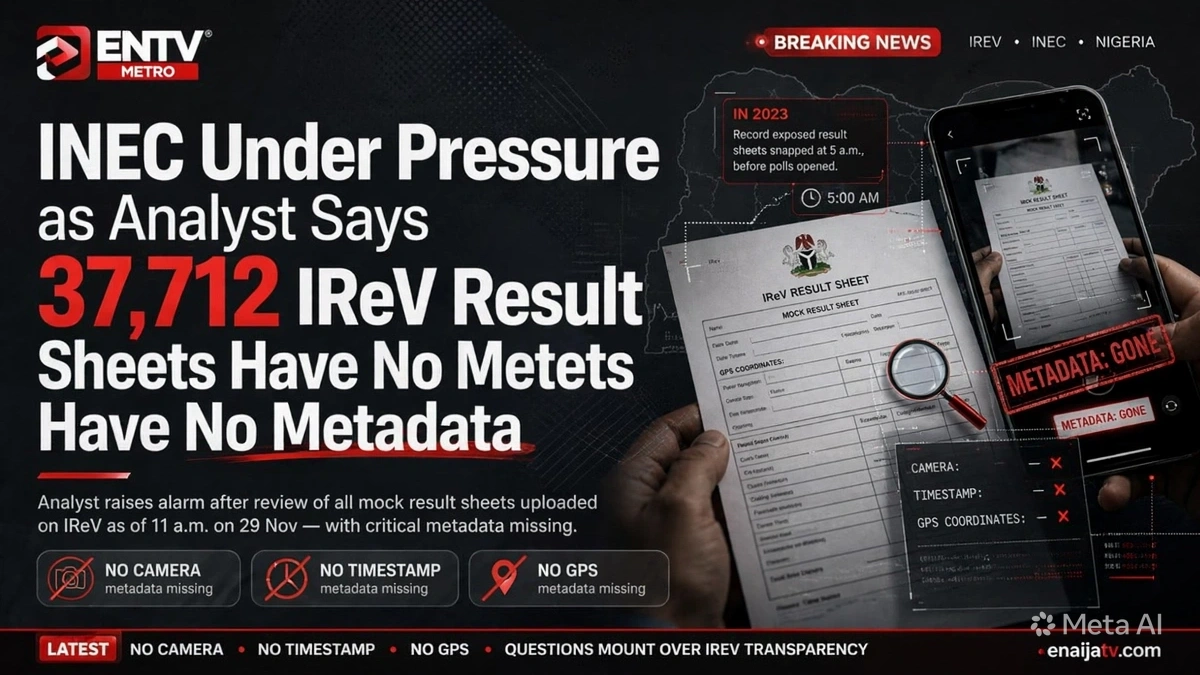
A fresh controversy surrounding Nigeria’s electoral transparency has emerged following a social media post alleging that thousands of mock election result sheets uploaded to the Independent National Electoral Commission’s (INEC) Result Viewing Portal (IReV) have no accompanying metadata.
The allegation was raised by social media user Mundus (@mundus01), who claimed to have analysed 37,712 mock result sheets available on IReV as of 11 a.m. on November 29, 2026.
In the post, Mundus expressed concern that the metadata associated with every examined document was missing, specifically pointing to the absence of camera information, timestamps and GPS location data.
The analyst also drew comparisons with Nigeria’s 2023 general elections, arguing that the availability of such information had previously helped expose the timing and circumstances surrounding the capture of uploaded result sheets.
The post directly tagged INEC, asking whether the alleged absence of metadata was part of the commission’s plan.
The allegation has raised important questions about digital election transparency, the preservation of election records and the ability of independent observers to verify the authenticity and circumstances of uploaded result documents.
The wider significance of this allegation is that it comes just days after INEC publicly assured election stakeholders that metadata attached to results uploaded to IReV would be preserved during the 2027 general elections.
That assurance makes the latest findings particularly important and places the commission under pressure to explain whether the information is genuinely missing, inaccessible through the public portal, or retained elsewhere in its internal systems.
What the Analyst Discovered on IReV
According to Mundus, the analysis covered 37,712 mock election result sheets that had been uploaded to INEC’s Result Viewing Portal as of 11 a.m. on Sunday, November 29.
The analyst specifically identified three categories of information that were allegedly missing:
- Camera information: Details that could help establish the device used to capture a result sheet.
- Timestamp information: Data that could help establish when a photograph was originally taken.
- GPS information: Location data that could help establish where the photograph was captured.
These details are important because they can provide an additional layer of information for examining the circumstances surrounding the creation and submission of election documents.
However, the absence of embedded metadata in a publicly accessible image does not automatically establish that a result sheet is fraudulent or that the information has been deliberately deleted. It is also important to establish whether the original files and their associated metadata remain available within INEC’s internal systems.
Why the 2023 Election Is Being Revisited
Mundus referenced Nigeria’s 2023 general elections, claiming that metadata analysis previously helped identify result sheets that appeared to have been photographed before voting officially commenced.
The analyst specifically referred to instances where result sheets were reportedly captured around 5 a.m. on election day.
Such findings, if independently established, raise serious questions about the circumstances under which election result documents were completed and photographed.
The concern is that timestamps and device information can help investigators distinguish between documents captured during the legitimate electoral process and those whose creation circumstances require further examination.
However, an early timestamp alone does not establish who prepared a document, whether it was subsequently altered or whether the document affected the final declared result. Each case requires examination of the original records and supporting evidence.
The 2023 elections also exposed wider challenges with electronic result viewing. An international observation report by the NDI and IRI documented delays in uploading presidential results, technical difficulties with IReV and concerns about incomplete result sheets during the collation process.
INEC Had Earlier Promised to Preserve Metadata
One particularly significant aspect of the controversy is that INEC had already addressed concerns about metadata preservation before the November 28 mock exercise.
On November 18, 2026, PREMIUM TIMES reported that INEC’s Director of Information and Communication Technology, Lawrence Bayode, assured stakeholders that metadata attached to election results uploaded to IReV would remain intact.
The assurance was given during a stakeholder roundtable on election results tabulation organised by Yiaga Africa in Abuja.
During the discussion, a participant from MundX Analytics raised concerns about the possibility of metadata being removed from uploaded election results.
Bayode reportedly responded:
“I can assure you those metadata will remain intact.”
He also stated that INEC still had metadata relating to elections in the Federal Capital Territory, Ekiti and Osun, although he said he could not speak for previous elections.
The latest allegation by Mundus therefore raises an important question: if INEC has committed to preserving metadata, why does the analyst say the information cannot be found on the 37,712 mock result sheets examined?
INEC’s explanation will be important in determining whether the problem concerns the public display of metadata, the processing of uploaded images or the preservation of original files.
What Happened During INEC’s November 28 Mock Exercise?
The metadata controversy comes against the background of INEC’s nationwide mock accreditation and results-upload exercise conducted on Saturday, November 28, 2026.
The exercise covered 17,676 polling units across the country and was designed to test the Bimodal Voter Accreditation System (BVAS), voter accreditation procedures and electronic transmission of polling-unit results to IReV ahead of the 2027 general elections.
Although INEC expressed satisfaction with aspects of the exercise, election observers identified several operational and technical challenges.
Yiaga Africa reported BVAS malfunctions, delayed commencement in some locations, low voter participation, and difficulties scanning and uploading result sheets.
The organization also identified discrepancies between INEC’s stated total of 177,299 polling units and the 176,846 listed on IReV.
It further reported that the IReV back-end contained 8,791 Registration Areas instead of the 8,838 designated for the exercise.
These findings have increased calls for INEC to address technical weaknesses before the next general election.
Why Metadata Matters for the 2027 Elections
The importance of metadata goes beyond the technical details attached to a photograph.
In an election where millions of Nigerians depend on electronic platforms to independently monitor polling-unit results, the ability to examine the history and circumstances surrounding uploaded documents is essential to public confidence.
For instance, timestamps can help establish when an image was created or uploaded, while device information can assist investigators in identifying patterns involving the use of particular devices.
Location information can also provide additional evidence when examining whether a document was captured at the appropriate polling location.
Nevertheless, metadata is not a substitute for the original signed result sheet, accreditation records, ballot accounting or the official collation process. It is one part of a broader verification process.
Preserving the original files, maintaining reliable upload logs and allowing authorized independent observers to examine relevant records would strengthen transparency.
What Nigerians Expect INEC to Explain
Following the allegation, attention has turned to the electoral commission for clarification.
Several important questions require answers:
- Were camera, timestamp and GPS metadata originally captured during the mock exercise?
- If the information is missing from publicly accessible result sheets, are the original metadata records still preserved on INEC’s internal servers?
- Why is the information not available for independent examination?
- Will INEC publish a technical explanation of how result images are processed before appearing on IReV?
- Will independent electoral observers be allowed to verify the integrity of the original files and associated records?
Providing clear answers would help address concerns before the 2027 general elections.
Electoral Transparency Must Be Demonstrable
The controversy highlights a broader challenge facing Nigeria’s electoral system: public confidence cannot depend solely on assurances that electoral technology is reliable.
The systems must also allow credible independent examination of the processes through which results are captured, transmitted, displayed and collated.
INEC has an opportunity to address these concerns while there is still time to improve its systems before the 2027 elections.
For Mundus and other election technology observers, preserving metadata is an important part of ensuring that electronic result viewing provides more than just photographs of completed result sheets.
The central question now is whether INEC can demonstrate that the original metadata remains intact and independently verifiable, as its ICT director previously promised.
As Nigerians look towards 2027, the commission’s response to this allegation could become an important test of its commitment to electoral transparency and accountability.
What is your reaction? Should INEC make the original metadata of every uploaded result sheet independently verifiable ahead of the 2027 elections? Share your opinion in the comment section.
This is sad.We just analyzed all 37,712 mock result sheets on IReV as of 11 a.m. on 29 Nov.The metadata on every one is GONE. No camera. No timestamp. No GPS.In 2023, this record exposed result sheets snapped at 5 am, before polls opened.@inecnigeria, is this the plan for 2027?THIS CANNOT BE ALLOWED TO HAPPEN.#IReV— Mundus (@mundus01) November 29, 2026