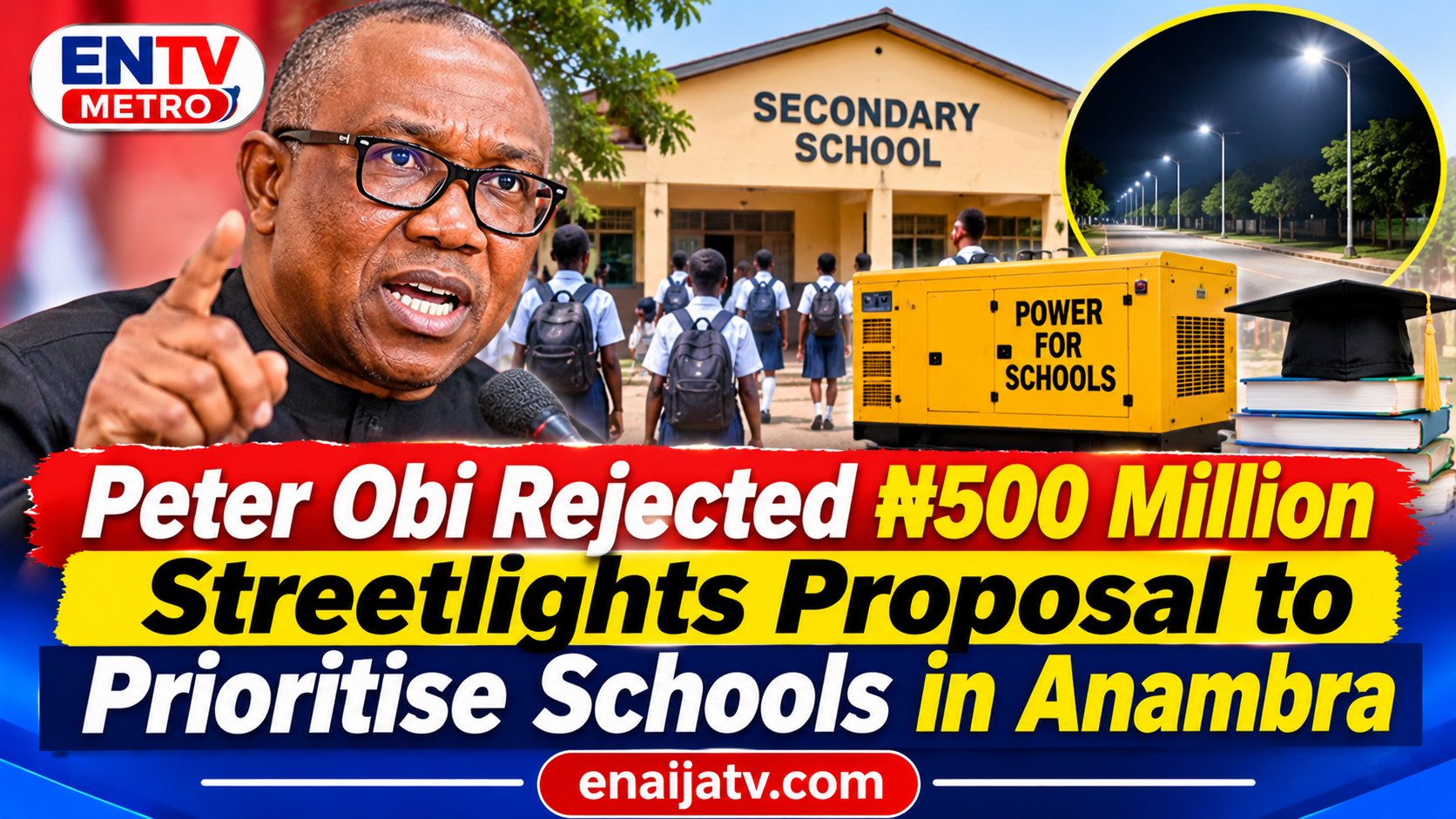
A fresh conversation about education, public spending and leadership priorities has emerged following accounts of how former Anambra State Governor Peter Obi reportedly rejected a ₦500 million streetlights proposal in favour of providing electricity to secondary schools during his administration.
Obi, who governed Anambra State from 2006 to 2014, reportedly questioned the justification for spending such a substantial amount on streetlights when many secondary schools across the state were still struggling without reliable electricity.
According to the account, he argued that people could return to their homes in darkness, but students should not be left without the basic facilities needed for learning.
The reported decision led to a redirection of attention towards providing generators for schools, with the broader objective of improving teaching, learning and access to essential educational facilities.
The story has reignited discussions about how governments should balance investments in public infrastructure with critical sectors such as education.
Why Obi Prioritised Electricity for Schools
The reported decision reflects an approach to public spending that placed considerable emphasis on educational infrastructure and the learning environment.
Rather than focusing exclusively on projects that would improve street lighting, Obi reportedly believed that schools required urgent attention because electricity was necessary for practical lessons, laboratories and other academic activities.
The account states that 40 KVA generators were provided for hundreds of schools, with an estimated cost of ₦1 million per generator.
However, available records of the former administration’s generator programme describe the procurement of 750 generators, including 450 units rated at 50 KVA, for public and mission secondary schools. The precise figures in the ₦500 million streetlights anecdote require further documentary confirmation.
Returning Mission Schools and Supporting Education
The generator story forms part of a wider record of educational interventions associated with Obi’s administration.
One of the major decisions was the return of mission schools to their original religious owners while retaining government support for teachers’ salaries and other educational responsibilities.
In January 2009, 18 secondary schools were returned to the Catholic and Anglican churches. In November 2011, another 1,040 primary schools followed.
Contemporary reporting indicated that the state government provided approximately ₦6 billion in grants to support the arrangement over 15 months while continuing to pay teachers’ salaries.
The policy was designed to restore the involvement of religious institutions in school management while maintaining public support for education.
Computers, Internet and Thousands of Teachers
Beyond the restoration of mission schools, the Obi administration also pursued investments in technology and human resources.
Available records and contemporary reports highlight several initiatives, including:
- Distribution of more than 30,000 computers to secondary schools, including 22,500 supplied by HP.
- Internet connectivity extended to more than 500 secondary schools.
- Establishment of Microsoft Academies in secondary schools.
- Provision of school buses to support transportation and other school activities.
- Construction and rehabilitation of classrooms and science laboratories.
- Recruitment of thousands of teachers to strengthen the education workforce.
An account of the administration’s record puts teacher recruitment at approximately 9,000, covering primary, secondary and special-subject teachers.
These initiatives were part of a broader effort to improve the educational environment and expand access to learning resources across the state.
Education Versus Infrastructure: A Continuing Debate
The story has also raised an important question about how governments should determine spending priorities.
Streetlights contribute to public safety, improve visibility and support economic activities after dark. Equally, electricity in schools can improve science education, digital learning and the quality of teaching.
The debate, therefore, goes beyond choosing one project over another. It highlights the importance of identifying urgent public needs, allocating available resources responsibly and ensuring that different sectors receive appropriate attention.
For supporters of Obi’s approach, the reported decision illustrates the importance of placing educational needs at the centre of government planning.
Others may argue that public lighting and security infrastructure are equally important and should not be neglected.
Obi’s ‘Go and Verify’ Challenge
Obi has continued to draw attention to his record in Anambra State, presenting his administration’s educational investments as examples of what he believes responsible management of public resources can achieve.
His repeated invitation to Nigerians to examine the projects and verify the figures has also brought renewed attention to the documentation of his eight-year administration.
As he continues his political engagements and town hall discussions ahead of the 2027 general elections, his record in education remains part of the wider conversation about governance, public spending and national development.
Ultimately, the discussion raises a fundamental question: should governments prioritise projects based on visibility, immediate public convenience or their long-term impact on human development?
What is your opinion? If a government had ₦500 million available, would you prioritise streetlights or electricity and essential facilities for public schools? Share your thoughts in the comment section.
My head of service said I was stingy because I asked “why do we need a street light when we don’t have light in secondary schools”.– Peter Obi. https://t.co/KVjKmiQVYZ— Taiwo (@mo_tayo02) November 28, 2026